
As we roll through the halfway mark of 2025 and return from winter escapes to warmer climes, it’s time to look at where the Melbourne Apartment Rental Market is at and where it’s going.
In an odd twist of fate, the Melbourne Rental Market has boomed due (in part) to the Victorian government’s land tax and compliance imposts. This has resulted in costs being passed on to renters and less properties in the rental pool. Unfortunately renters are paying the price both literally and figuratively as it becomes harder to find a home. Investment owners have been forced to pass on the costs or sell up. They would prefer not to do either. Both options are bad news for renters but owners have little choice.
As the below table shows, the median rent for inner city apartments has continued to rise by up to 9.1% in Richmond. Today, rent for a typical 1-bedroom apartment in Port Melbourne or Southbank is $550/wk. It seems like yesterday when it was $450/wk.
| Suburb | 12 mth change | 1 Bed | 2 Bed | 3 Bed |
| Abbotsford | -5.2% | $495 | $635 | $875 |
| Docklands | 4.6% | $570 | $740 | $1,200 |
| Melbourne | 0.0% | $550 | $710 | $1,050 |
| Port Melbourne | 5.4% | $550 | $717 | $1,075 |
| Prahran | 5.8% | $450 | $650 | $962 |
| Richmond | 9.1% | $500 | $685 | $1,000 |
| South Melbourne | 5.0% | $540 | $680 | $980 |
| South Yarra | 3.5% | $495 | $697 | $1,050 |
| Southbank | 3.8% | $558 | $700 | $1,000 |
| St Kilda | 5.0% | $450 | $600 | $825 |
Source: realestate.com.au
Looking at the 5 year rental chart for each suburb (available in the link for each), they show an upward rental trend for most suburbs suggesting rents will keep rising throughout the next 12 months. Most researchers suggest the rate of growth will taper to a slightly slower growth rate.
You can search your own suburb here if it is not shown above.
According to SQM Research, the rental market vacancy rate for all rental property in Melbourne is 1.8%. Interestingly the vacancy rate is tighter in all other cities other than Canberra. This means the rental market interstate is even tougher than Melbourne so expect to see more people moving in than out to find a home.
National Vacancy Rates (source: SQM research)
- Adelaide – 0.8%
- Brisbane – 0.9%
- Canberra – 1.5%
- Darwin – 0.5%
- Hobart – 0.6%
- Melbourne – 1.8%
- Perth – 0.8%
- Sydney – 1.6%
The recent and forecast rental growth is positive for investment income, but what about the cost side?
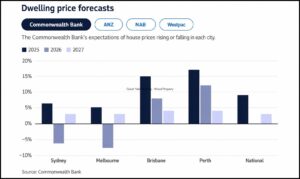
Interest rates are forecast to fall by 0.50% to 0.75% by February 2026. Land Tax (albeit annoying) is relatively low for apartments due to their low land value component. Most modern apartments easily meet the compliance requirements so that is not adding much additional cost either.
So with rising rents and falling interest rates, the investment numbers are getting more attractive all the time. It is little surprise therefore we are starting to see more investors getting back in to the Melbourne apartment market. Especially from Brisbane and Sydney. Investment buyers are starting to see the value both now, and over the next 5 or so years.
What’s becoming clearer is that Melbourne’s apartment rental market is evolving into a tale of two realities: renters navigating shrinking availability and rising rent, and investors rediscovering a more compelling yield story. With investor activity showing early signs of a rebound, the balance of power could shift slightly. But only if new supply starts to match demand.
Therein lies the challenge. Apartment construction pipelines remain thin, constrained by high building costs, planning delays, and relative low apartment prices. Without a notable uplift in completions, the pressure on the existing rental pool won’t ease anytime soon.
For tenants, the message is clear: secure your lease early and be prepared to compete. For investors, the fundamentals are aligning more positively than they have in years. Melbourne, with its population growth and relative affordability, stands out as a city of opportunity.