
Here are the changes to capital gains tax (CGT) and negative gearing as announced by Jim Chalmers in last night’s Federal Budget and foreshadowed in our last update. The impact on apartment owners in Melbourne will actually be minimal. There are several reasons for this which are detailed below. CGT and the rule changes apply to all assets so switching asset classes unfortunately does not avoid the changes.
Existing property owners have emerged from the reforms in a far stronger position than many feared. The government has avoided introducing retrospective changes that would destabilise current investors or trigger disruption across the housing market generally.
Firstly let’s look at what has changed by segment.
- A. Currently held investment property
- New buyers of existing properties
- New buyers of newly constructed property
Then let’s look at what the impact is likely to be.
1. – Currently held investment property
For current investors, there is no change to negative gearing. Keep doing what you have been doing for as long as you own that property. Your current investment therefore enjoys a special privilege over newly acquired investment property.
Changes to CGT changes are;
- The 50% discount to capital gain remains up to 1st July 2027
- Any capital gain from 1st July 2027 to the sale date, will be calculated as the sale price, less the value at 1st July 2027 (but after adding an inflationary index like(CPI)
- The tax paid on this amount is your marginal tax rate with a 30% floor.
- Even pre 20th September 1985 owned property (CGT free) come under the new rules from 1st July 2027. Sorry Grandpa.
That means:
- Existing owners can continue to negatively gear their properties under the current system for as long as they own that property.
- Capital gains accumulated prior to 1 July 2027 retain access to the existing 50 per cent CGT discount framework.
- Capital gain after 1st July 2027 is fully taxable less the inflation index calculation.
This means if you are a long-term owner, you (your accountant) will need to calculate a blended CGT when you eventually sell.
Here is an example:
- An investor purchases an apartment for $500,000 in 2016
- On 1 July 2027 the property is worth $600,000
- The investor then sells the property in 2032 $700,000
Under the new rules:
- The first $100,000 gain (from $500,000 to $600,000) will enjoy a 50% discount to the CGT calculation. So only $50,000 is taxable. ($100,000 x 50%)
- The later $100,000 gain (from $600,000 to $700,000) will all be taxable after deducting an inflation index (CPI) to the $600,000 (say 10% = $660,000) over the period post 1st July 2027. So $700,000 less $660,000 -> Taxable gain is $40,000.
- So total taxable gain would be $50,000 + $40,000 = $90,000
- A 30% minimum or tax floor will apply on the capital gain regardless of your personal taxable income.
While current investors are not completely exempt from future changes, they are still better positioned than buyers entering the market after the reforms commence.
2 – New buyers of existing property
Here are the changes
- Negative gearing is not permitted
- CGT changes apply from 1st July 2027 as detailed above.
This is where the government has applied the greatest pressure mainly by removing negative gearing. The actual impact will depend on the property you buy and your personal situation.
Remember negative gearing is the ability to use the loss incurred from an asset, and off set (deduct) it from your personal income. So if you buy an asset that is throwing out cash (positively geared) then you / it wont be impacted by the negative gearing changes. Or if you move into a low taxable income (retirement phase) any further loss from a property is of no value anyway.
All the current tax deductible costs such as interest payments, depreciation, maintenance, management fees and compliance charges all remain as tax deductible against the rental income.
Generally speaking, loan-to-value ratios need to be above roughly 70% before the asset begins producing a negative taxable income outcome.
Plus if your asset does incur a loss one year, you will be able to carry that loss forward to the next year and offset it from a profit. So a major repair or refurbishment cost is not all lost.
Clearly the government wants fewer investors bidding against first home buyers for established housing stock. In Melbourne, investors have been largely absent from the property market for a few years anyway so the changes will have very little impact.
3 — New buyers of newly constructed property
The government is attempting to redirect investor demand toward newly built housing by preserving significantly more attractive tax treatment for new construction. Unfortunately as construction costs soar and values plateau, new builds remain largely unviable. Especially in Victoria.
Here are the changes for buyers of newly built residential property.
- Negative gearing is available.
- CGT is a choice between the current 50% discount or the inflation index system.
Canberra is trying to create a tax system where investors are rewarded for adding supply rather than simply trading existing homes. So if you own a block of land with a single home and you demolish and build 2 or 3 new homes, buyers of those new homes will enjoy these tax privileges.
This may help Melbourne’s apartment development sector if confidence returns and project feasibility improves.
But there is still a challenge. Construction costs, planning delays, labour shortages and elevated finance costs continue to make many projects difficult to deliver profitably. Tax incentives alone may not be enough to fully solve the supply shortage.
Trust tax changes
Separate to the property reforms, the budget also introduces changes to discretionary trusts but SMSF are exempt. This is designed to eliminate tax by splitting income amongst your family.
From 1 July 2028:
- Discretionary trusts will face a minimum tax rate of 30 per cent.
- The reforms target income-splitting strategies commonly used by higher-income households.
- Fixed trusts and superannuation structures remain exempt.
- Transitional relief measures will apply for restructures.
Likely impact of the changes
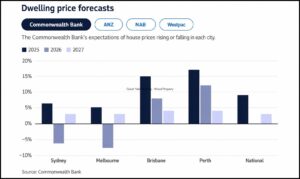
If the goal is to make homes more affordable for younger people by removing investors from the market, then in Melbourne the impact will be negligible. There is already a very small number of investors in the market. Certainly not enough to be setting a premium on the price of property, over and above owner occupiers. Even sales generally to home buyers have fallen due to the cost of living challenges and higher interest rates.
Existing owners of investment properties are more likely to hold than sell to preserve their negative gearing allowance. So less homes for sale for people to buy. Upward pressure on prices.
New investment buyers of existing property will need to pass on much of the additional costs to the renter. Higher rent makes it harder for renters to save a deposit to buy a home.
Ultimately, the budget is less an attack on existing property investors and more an attempt to reshape where future investment capital flows.
The government is betting that encouraging new construction while reducing investor demand for established housing will improve affordability over time.
Whether that works will depend on whether enough new housing actually gets built.