New data has revealed a fall in rental stock with almost 6,000 rental properties disappearing from Victoria’s rental market over the past year.
The figures, published in the Victorian Government’s June Quarter 2026 Rental Report, shows a decline in rental stock across the state. Like all property analysis the results vary by location and property type.
The specific impact on rents over the next few years will again vary by property type and location.
Wood Property has examined the correlation between the recently released rental bond data and the median rent for two-bedroom apartments across 10 Melbourne suburbs.
The findings confirm our long held view that the drop in rental availability is driving an increase in rents. This is especially pronounced over the past three to four years where rental stock has fallen and rental values have risen.
There is nothing to suggest this trend won’t continue with rents set to keep climbing. This may seem good news for owners but it is heartbreaking for renters. Also this sort of market disruption is problematic for everyone longer term as it creates uncertainty and a higher risk for developers trying to bring new homes to life in a volatile market.
What the rental bond data tells us
The Victorian Government records rental bond lodgements when properties are leased to new tenants. We have used this as a proxy for total rental stock. Fewer rental bond lodgements mean fewer rental properties. There is a bit of noise in the data, but over an extended sample period the data is more reliable.
We then compared the number of new rental bonds with median weekly rents to see the correlation.
We used data for only two-bedroom apartments allowing us to compare similar accommodation across different suburbs.
The results shown below reveal some interesting findings.
Will Melbourne rents keep rising?
The trend looks ominous for tenants with rents likely to keep rising. Particularly in established suburbs where new construction is difficult.
Our analysis of 10 suburbs shown below reveals a recurring pattern over the past three to four years. Rental bond lodgements have generally fallen or experienced slower growth while median rents have continued to rise.
The land tax changes introduced in January 2024, together with the Federal Budget reforms announced in May 2026, are discouraging investment in both new and established rental properties.
If the current investor sell-off continues, and new rental construction fails to replace the accommodation being lost, rental availability is likely to tighten further.
That would create conditions for continued rental increases and further improvement of rental yields for investors
Suburb by Suburb Analysis
Median rents and rental bond lodgements for 2 bedroom apartments.
1. Abbotsford – Collingwood
Last 3 years (2023–2026)
- Median weekly rent: $600 → $720 (↑ 20.0%)
- Annual bond lodgements: 872 → 663 (↓ 24.0%)
Last 10 years (2016–2026)
- Median weekly rent: $500 → $720 (↑ 44.0%)
- Annual bond lodgements: 969 → 663 (↓ 31.6%)
Market observation: Abbotsford has experienced one of the largest reductions in rental bond lodgements, falling 32% over ten years while rents increased 44%. The trend has accelerated over the past three years.
2. Docklands
Last 3 years (2023–2026)
- Median weekly rent: $650 → $800 (↑ 23.1%)
- Annual bond lodgements: 1,439 → 1,471 (↑ 2.2%)
Last 10 years (2016–2026)
- Median weekly rent: $560 → $800 (↑ 42.9%)
- Annual bond lodgements: 960 → 1,471 (↑ 53.2%)
Market observation: Docklands differs from established suburbs. New apartment construction has contributed to generate growth in leasing activity over ten years. However, bond lodgements have barely increased over the past three years with rents rising 23%.
3. Melbourne CBD – St Kilda Rd
Last 3 years (2023–2026)
- Median weekly rent: $650 → $750 (↑ 15.4%)
- Annual bond lodgements: 6,861 → 6,461 (↓ 5.8%)
Last 10 years (2016–2026)
- Median weekly rent: $550 → $750 (↑ 36.4%)
- Annual bond lodgements: 3,905 → 6,461 (↑ 65.5%)
Market observation: Despite substantial growth in apartment leasing activity over the past decade, the past three years show a reversal, with bond lodgements declining while rents continue rising.
4. Port Melbourne
Last 3 years (2023–2026)
- Median weekly rent: $650 → $750 (↑ 15.4%)
- Annual bond lodgements: 423 → 349 (↓ 17.5%)
Last 10 years (2016–2026)
- Median weekly rent: $570 → $750 (↑ 31.6%)
- Annual bond lodgements: 582 → 349 (↓ 40.0%)
Market observation: Port Melbourne has experienced the largest ten-year decline in bond lodgements of the suburbs examined, falling 40%. Meanwhile, median rents have increased 32%, suggesting increasingly constrained rental market activity.
5. Prahran – Windsor
Last 3 years (2023–2026)
- Median weekly rent: $540 → $650 (↑ 20.4%)
- Annual bond lodgements: 759 → 623 (↓ 17.9%)
Last 10 years (2016–2026)
- Median weekly rent: $450 → $650 (↑ 44.4%)
- Annual bond lodgements: 842 → 623 (↓ 26.0%)
Market observation: Prahran has experienced a sustained reduction in leasing activity, with bond lodgements falling 26% over ten years. Over the same period, rents have increased 44%.
6. Richmond – Burnley
Last 3 years (2023–2026)
- Median weekly rent: $600 → $700 (↑ 16.7%)
- Annual bond lodgements: 956 → 751 (↓ 21.4%)
Last 10 years (2016–2026)
- Median weekly rent: $500 → $700 (↑ 40.0%)
- Annual bond lodgements: 863 → 751 (↓ 13.0%)
Market observation: Richmond’s decline in leasing activity has accelerated considerably. Bond lodgements have fallen 21% over just three years, compared with a 13% reduction over the full decade.
7. South Melbourne
Last 3 years (2023–2026)
- Median weekly rent: $600 → $750 (↑ 25.0%)
- Annual bond lodgements: 470 → 532 (↑ 13.2%)
Last 10 years (2016–2026)
- Median weekly rent: $515 → $750 (↑ 45.6%)
- Annual bond lodgements: 378 → 532 (↑ 40.7%)
Market observation: South Melbourne is an exception to the broader pattern. Both rents and bond lodgements have increased substantially, demonstrating that rental growth can occur alongside increased leasing activity when tenant demand is strong.
8. South Yarra
Last 3 years (2023–2026)
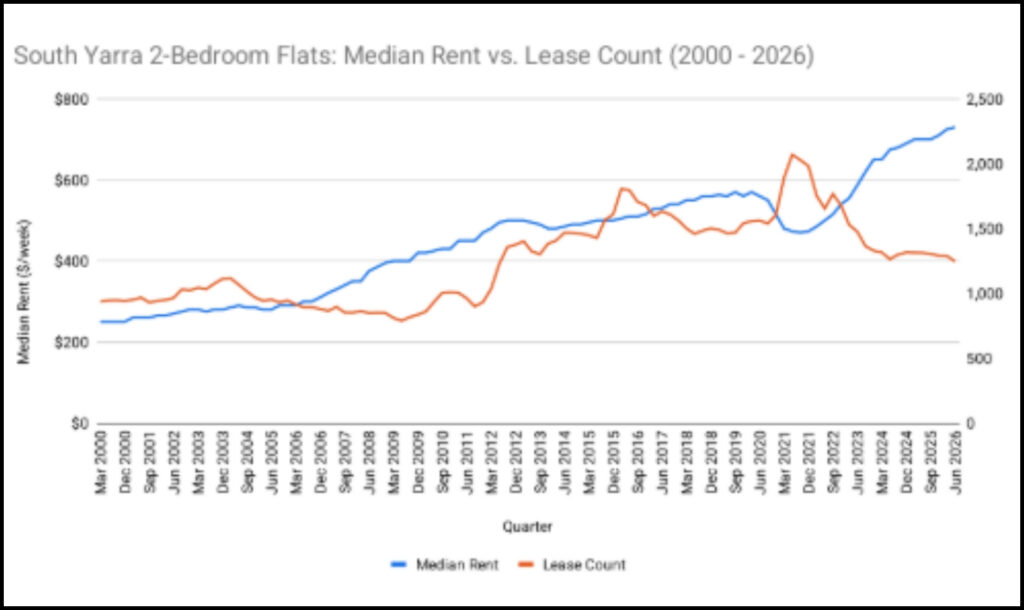
- Median weekly rent: $587 → $730 (↑ 24.4%)
- Annual bond lodgements: 1,476 → 1,247 (↓ 15.5%)
Last 10 years (2016–2026)
- Median weekly rent: $510 → $730 (↑ 43.1%)
- Annual bond lodgements: 1,795 → 1,247 (↓ 30.5%)
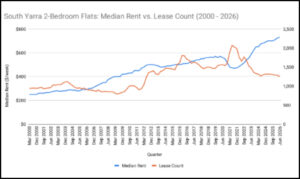
Market observation: South Yarra demonstrates a sustained divergence between rental prices and leasing activity. Over ten years, bond lodgements have dropped 31% while rents have increased 43%.
9. Southbank
Last 3 years (2023–2026)
- Median weekly rent: $630 → $750 (↑ 19.0%)
- Annual bond lodgements: 2,543 → 2,353 (↓ 7.5%)
Last 10 years (2016–2026)
- Median weekly rent: $550 → $750 (↑ 36.4%)
- Annual bond lodgements: 1,837 → 2,353 (↑ 28.1%)
Market observation: Southbank has experienced substantial growth in rental activity over the past decade, largely reflecting apartment development. However, the past three years show declining bond lodgements alongside rising rents.
10. St Kilda
Last 3 years (2023–2026)
- Median weekly rent: $500 → $650 (↑ 30.0%)
- Annual bond lodgements: 1,091 → 1,035 (↓ 5.1%)
Last 10 years (2016–2026)
- Median weekly rent: $450 → $650 (↑ 44.4%)
- Annual bond lodgements: 1,300 → 1,035 (↓ 20.4%)
Market observation: St Kilda has experienced the strongest rental growth over the past three years of the suburbs examined, with median rents increasing 30% while annual bond lodgements declined 5%.
The gap is likely to continue to widen
There is nothing to suggest that this trend won’t continue. Rents rising and rental stock falling. The only twist could be investors returning to the market as rental yields get better and better.