
The daily news is full of reports about the housing market and how we are in a housing crisis.
The headlines say there are not enough homes, rents are soaring and prospective renters are climbing over each other to secure a home.
But is that actually what is happening in Melbourne? Or is it more an affordability issue with cost of living pressures weighing down the market.
There is little doubt that over a 50 year timeline housing affordability has become a serious problem despite the recent cooling of values. For many households, rent is taking an increasingly large bite out of the weekly budget making it really hard to save and buy a home.
Looking specifically at apartments and houses offered for sale or rent across Melbourne, we can see the issue is a little more nuanced than simply saying there is a housing crisis.
One way to get a window into the sale and rental market and the “housing crisis” is to look at how long it takes for each property to be sold or leased. This tells us if property is flying off the shelf or if it is struggling to move.
We picked 10 suburbs for Houses and 10 for Apartments and looked at the “days on market” for sales and rentals.
Houses for Sale / Lease
| Suburb | Number for Rent |
Median Rent / Week |
Days to Lease |
For Sale | Median Sale Price |
Days to Sell |
|---|---|---|---|---|---|---|
| St Kilda | 22 | $890 | 23 | 32 | $1,593,000 | 27 |
| Richmond | 60 | $900 | 17 | 77 | $1,345,000 | 25 |
| Brunswick | 53 | $805 | 15 | 59 | $1,250,000 | 25 |
| Footscray | 37 | $640 | 21 | 50 | $910,000 | 27 |
| Truganina | 275 | $520 | 30 | 337 | $676,050 | 61 |
| Werribee | 284 | $470 | 30 | 257 | $674,000 | 41 |
| Reservoir | 97 | $600 | 22 | 127 | $950,000 | 27 |
| Heidelberg | 6 | $700 | 22 | 12 | $1,450,000 | 27 |
| Dandenong | 34 | $570 | 25 | 59 | $745,000 | 30 |
| Mentone | 16 | $815 | 20 | 26 | $1,370,000 | 31 |
Apartment and Unit for Sale / Lease
| Suburb | For Rent | Median Rent / Week | Days to Lease | For Sale | Median Sale Price | Days to Sell |
|---|---|---|---|---|---|---|
| Melbourne CBD | 1,060 | $675 | 22 | 721 | $460,000 | 47 |
| St Kilda | 280 | $550 | 18 | 133 | $518,000 | 31 |
| Richmond | 164 | $600 | 17 | 95 | $549,000 | 26 |
| Brunswick | 103 | $580 | 15 | 75 | $571,000 | 28 |
| Footscray | 203 | $550 | 21 | 115 | $472,500 | 40 |
| Southbank | 530 | $700 | 23 | 373 | $540,000 | 53 |
| South Melbourne | 103 | $660 | 23 | 73 | $605,000 | 34 |
| Hawthorn | 148 | $550 | 17 | 100 | $582,000 | 26 |
| Doncaster | 62 | $650 | 20 | 97 | $632,000 | 40 |
| Box Hill | 170 | $600 | 23 | 161 | $500,000 | 44 |
When you scan these tables, two things hit you.
Firstly, (price aside) there are actually a lot of properties for sale or lease.
Secondly, there is a huge variation between suburbs. Werribee has 284 homes for rent with 30 days on market. Mentone has 16 for sale and a median of 20 days on the market.
In the apartment table Melbourne 3000 (CBD) has 1,060 apartments for rent in the last month. Maybe this is distorted with apartments actually being available for short stay that remain advertised for rent as short stay renters come and go.
These numbers don’t seem to correlate with a Housing Crisis.
What we are seeing at inspections
Our experience at Wood Property (and in discussions with agents) is that the rental market is not as frothy as the media may suggest. When the asking rent tips over the top, renters look elsewhere or explore other options.
While we continue to see a steady level of enquiry and attendances at open for inspections, it is not fever pitch. Recent research show median rents have plateaued.
The drop off in the sales market is creating a downturn in values. Understandably it takes time for some sellers to adjust to the new pricing. Owners who hold on to the original asking price are seeing a blow out in days on market.
For both the sale and rental markets, properties that are well presented and correctly priced, get good interest and are generally moving in 20 – 30 days.
If Melbourne were suffering from an acute shortage where renters had almost no alternative, you would expect almost every property to be snapped up immediately.
That is not what we are seeing.
Housing crisis or affordability crisis?
None of this suggests Melbourne does not have a housing problem. We definitely need more apartments and more houses over the medium to longer term. .
There are many households who face real difficulty securing appropriate accommodation to meet their financial and housing needs.
Melbourne’s vacancy rate remains tight by historical standards. But it is worth asking whether the phrase “housing crisis” has become a catch-all explanation for what is actually an affordability problem.
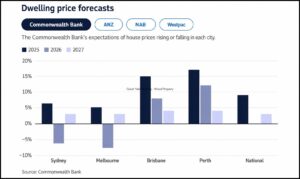
While the sales market has fallen, it is a correction in a longer term growth story. Domain reported that Australia’s housing downturn deepened during the September quarter, with house prices falling across every capital city for the first time in 15 years.
Higher interest rates, tax changes, weaker confidence and cost-of-living pressures were all weighing on purchasers. We are also starting to see a weakening in the employment market.
In Melbourne, some higher-value property segments have fallen more than 10 per cent from their peak.
These are not the outcomes you would expect from a market with a “housing crisis”.
Cost of living changes the equation
While housing (shelter) sits high in Maslow’s hierarchy of needs, it is a crowded space with lots of other demands on the budget.
Cost of living pressures on food, energy, insurance, transport and other everyday expenses continue to rise. Eventually something has to give.
People make a choice and for many households, that may be housing or quality of housing and living standards.
They compromise on location, space, quality or the number of people they live with.
The result is that demand adjusts, even though the underlying desire for housing remains.
So yes, Melbourne has a housing problem but it is driven more by economics and cost of living rather than just the supply of housing.